
History of the Black Ferns and Springbok Women

By 2010, 89 years after the All Blacks and Springbok men had first met on a rugby field, their female counterparts finally got to match their achievement. It wasn’t at Eden Park, or Ellis Park or even in New Zealand or South Africa. It was at the University of Surrey in Guildford, England, part of that year’s Women’s Rugby World Cup.
Two very different journeys
By that time, the Black Ferns had won three World Cups in a row, but remained resolutely amateur and was achieving its success through the incredible determination of a core group of players and staff. At least it had a provincial competition and television coverage, by contrast their South African counterparts had only formed a national team in 2004 and had a pretty rough introduction to test rugby, beaten 101-0 by England in only their fourth game.
They were managing to do something the men’s game in their country wasn’t, though, as the fresh 21st century start the team now dubbed the Springbok Women saw a team running out that was truly representative of South Africa. In fact, throughout its history the side has been overwhelmingly coloured, in complete contrast to the way their male counterparts’ history ran. Flanker Mandisa Williams from the Eastern Cape was one, and was also the captain.
This is something that the Black Ferns can boast too, as they have been proudly and predominantly Māori and Pasifika in their makeup since they first took the field. Included in the team was future captain Fiao’o Fa'amausili, who would later hold the record for most Black Ferns caps and become an Officer of the New Zealand Order of Merit.
2010: A one-sided Rugby World Cup opener
By the time they were due to play the Black Ferns in their opening match of the 2010 World Cup the Springbok Women were on a bit of a roll. They’d won four tests in a row, but the challenge awaiting them across the park was a daunting one. Emma Jensen and Anna Richards, the Black Ferns’ halfback and first five combination, had both played more tests each than the Springbok Women had played in their entire history. The Black Ferns were heavy favourites to retain the title they’d won in 2006, and this opening game was expected to be a mere formality.
Unfortunately, this isn’t a story of the plucky underdogs rising to the occasion and pulling off an upset, or even giving their much more fancied opponents a fright. The Black Ferns ran away with the game without much trouble, leading 38-0 at halftime. The Springbok women fared a bit better in the second but eventually lost 55-3, with Black Ferns legend Carla Hohepa scoring a hat trick. Springbok women coach Denver Wannies summed up the one way traffic pretty well by admitting: "It's just a pity we couldn't stand up to the challenge from the world champions but as I said once again, they are not world champions for nothing."
WATCH: Every try the Black Ferns have scored against South Africa
2025: A first-ever quarterfinal for the Springbok Women
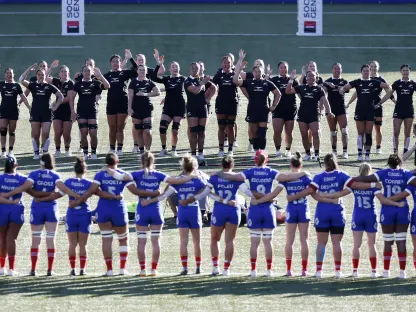
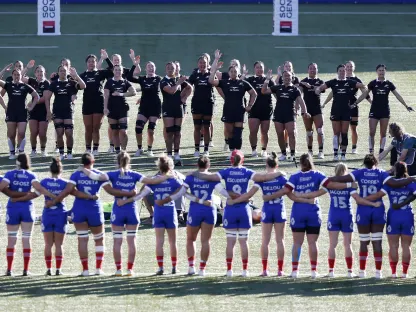
It took another 15 years for the sides to meet again. It was under the same circumstances: at a World Cup in England, but the scale of the occasion had increased dramatically. 12,000 fans packed into Sandy Park in Exeter for the Black Ferns and Springbok Women’s quarterfinal, with the South Africans the fairytale team of the tournament.
Nolusindiso Booi’s side had stunned Italy 29-24 in pool play, but few gave them much hope of getting past the defending champions. But what followed after the ball was kicked off into the bright sunshine ranks as one of the finest halves in South African rugby history.
The South Africans ploughed into the Black Ferns, taking a direct route up the middle using their big forwards. So it was no surprise when Babalwa Latsha opened the scoring after 20 minutes, crashing over following sustained pressure to the ecstasy of the large contingent of expat supporters. The Black Ferns hit back with tries from Theresa Setefano and Braxton Sorensen-McGee, but the brave Springbok Women refused to buckle. Right on half-time, Aphiwe Ngwevu powered over to level the contest at 10-all, a massive turnaround from the last time the sides met.
However, the Black Ferns came flying out in the second half, scoring three tries in the first seven minutes. With that big deficit established, South Africa struggled. But they managed a consolation try from replacement Lerato Makua in the closing stages, but the Black Ferns eventually ran out 46-17 winners.
Soweto, South Africa: The next chapter
The two sides meet again in the largest venue to ever host a women’s test match, the vast FNB Stadium in Soweto. While the Black Ferns will go in again as favourites, will we see yet another improved performance from the Springbok Women?
Springbok Women v Black Ferns
Saturday 5 September, kick-off 11.30 PM NZT
FNB Stadium, Soweto, Johannesburg
Watch live on Sky Sport NZ