
Lower tackle height laws to be trialled at World Rugby U20 Championship

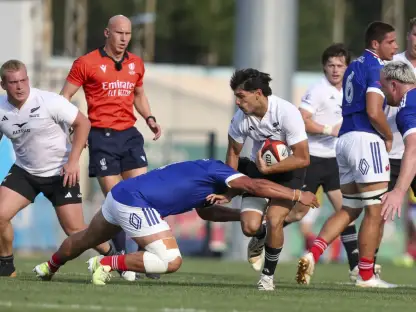
Trials across 11 unions worldwide over the last two seasons showed that lower tackle heights, below the sternum, have changed player behaviour, with some unions reporting a reduction in concussion rates.
Those involved in recommending changes worked with the International Rugby Players' Association, Test match officials, representatives from the Six Nations, Rugby Championship, Major League Rugby, Ligue Nationale de Rugby, the Rugby Football Union, South Africa's Rugby Union, Sanzaar, the French Federation of Rugby, and independent experts.
World Rugby chairman Dr Brett Robinson said, "Player welfare is at the heart of everything World Rugby does. We'll leave no stone unturned in our efforts to make the game as safe as it can be.
"Having said that, protecting what makes rugby rugby is a vital part of my role.
"We'll undertake this trial, study it closely to ensure we have a game, and an Under-20 Championship that excites players and fans alike."
World Rugby's executive board has recommended to the World Rugby Council that the opt-in trials become full law from July 2026.
Unions then requested that the trial be expanded into a closed trial at the elite rugby level.
The trials include associated law measures aimed at protecting rugby's character.
They allow: 'pick and go' actions near ruck and for players in the act of scoring, where the tackling below the sternum is harder to tackle below on a lower ball carrier; ball carriers who lead dangerously with their heads into contact will be sanctioned; double tackles will be allowed, so long as the first tackler makes contact below the sternum.
World Rugby said trialling the laws within a single competition will allow teams to prepare to play under the amended laws.
It will also allow referees time to focus on ensuring the law is practically applied, so players will not have to move between different law environments.
An intensive programme of education and training will be provided.
But no changes to other elite levels will be made until the outcome of the Under-20 trial is assessed against safety and spectacle measures.
Any changes to the game overall will require a robust evidence base and the support of the World Rugby Council.